
Supporting Research and Insights
Every Product Should Be Able to Speak
A product is not fully available when the customer can hold it, buy it, and take it home—but cannot independently identify it or understand what is inside.
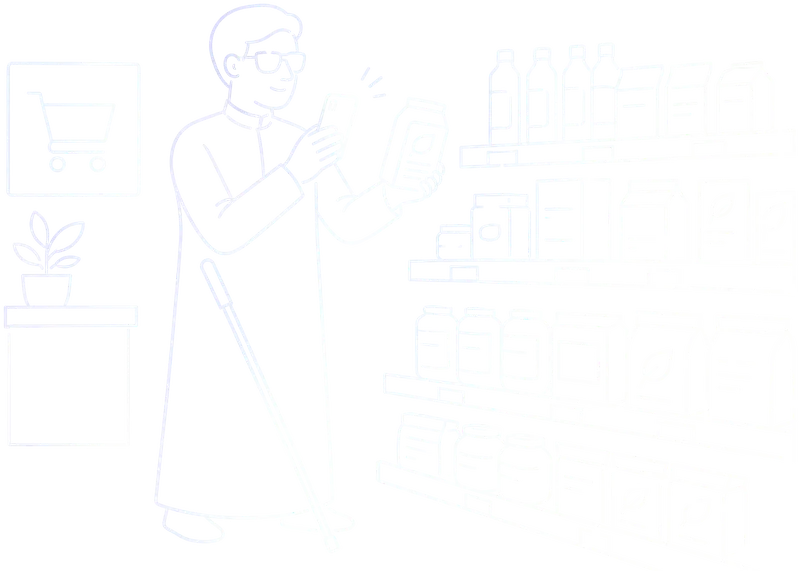
Packaging Is an Information Barrier
Product packaging communicates essential information:
- Product name and variant.
- Ingredients.
- Allergens.
- Expiry date.
- Dosage or usage instructions.
- Nutritional information.
- Safety warnings.
- Storage conditions.
- Manufacturer and origin.
Most of this information is presented in small printed text. For blind and visually impaired customers, the product may be physically available while its essential information remains inaccessible.
WHO estimates that at least 2.2 billion people worldwide live with near or distance vision impairment. Accessible packaging therefore addresses a large and growing audience, particularly as populations age.
The Royal National Institute of Blind People reports that nine in ten people with sight loss find packaging information difficult or impossible to read.
A 2025 GS1 UK survey of 500 visually impaired adults found that:
- 83% found food-packaging information difficult or impossible to access.
- 41% had purchased food containing an ingredient they were trying to avoid.
- 37% reported experiencing an allergic reaction connected to inaccessible labels.
- 53% had asked strangers for assistance.
- Only 40% had previously had the opportunity to use QR codes to obtain product information.
These findings show that inaccessible packaging is not simply an inconvenience. It can affect safety, privacy, independence, confidence, and the customer’s ability to make informed choices.
Saudi Evidence and Regulatory Direction
Saudi research has documented similar challenges, particularly in medication use.
A Saudi study of blind patients found that the most common challenges included:
- 75% experiencing difficulty identifying medications.
- 82% facing difficulty recognizing the correct dose.
- 92% facing difficulty identifying expiry dates.
- 91% believing Braille labeling would help them use medications more effectively.
A more recent study involving pharmacists and visually impaired participants in the Qassim region found continuing demand for improved labeling and packaging, including Braille, tactile identifiers, and clearer print.
The Saudi Food and Drug Authority has issued guidelines addressing Braille requirements for human medicinal products, with the purpose of improving access to medication information for people with visual impairment. The SFDA has also operated electronic labeling systems that connect users with approved digital medicine information.
International regulation is also moving toward connected packaging. In May 2026, the Spanish Agency for Medicines and Medical Devices published instructions allowing QR codes and other mobile-scanning technologies to provide statutory and supplementary medicine information, including audio content where approved.
What Accessible Product Information Should Provide
- Automatic or easy product identification.
- Product name and variant.
- Ingredients and allergen warnings.
- Usage, dosage, or preparation instructions.
- Expiry and storage information.
- Arabic and additional language options.
- Audio output compatible with screen readers.
- Information maintained by the manufacturer or authorized provider.
- Consistent placement across the product range.
- Privacy and independence during shopping and use.
Strategic Relevance to Noor Path and NoorTags
NoorTags can extend the Noor Path ecosystem beyond navigation and into accessible commerce.
Instead of depending only on a staff member, family member, or generic image-recognition application, the user could receive structured and verified information assigned to the product.
Potential sectors include:
- Food and beverages.
- Pharmaceutical products.
- Cosmetics and personal care.
- Household products.
- Retail shelves.
- Restaurant menus.
- Equipment and appliances.
- Government and service documents.
The opportunity is not to replace legally required labels. It is to create an additional accessible layer that makes the same information easier to discover and understand.
Key Figures and Takeaways
- 9 in 10 people with sight loss struggle with packaging information.
- 83% found food-label information difficult or impossible to access.
- 92% of surveyed blind Saudi patients struggled to identify medication expiry dates.
- Accessible information supports safety, privacy, independence, and informed choice.
Sources
- WHO — Blindness and Vision Impairment
- RNIB — Accessible Packaging Campaign
- GS1 UK — Accessibility in Food Shopping Survey
- Saudi Pharmaceutical Journal — Medication Use by Visually Impaired People
- Exploring Medication Use by Blind Patients in Saudi Arabia
- SFDA — Braille Labeling Requirements
- AEMPS — QR and Mobile-Scanning Technologies on Medicines